Monday, May 8, 2017

SAP MM Organizational Structure

SAP MM Organizational Structure

This tutorial is part of SAP MM training course and it explains about SAP MM organizational structures. After following the tutorial, you will learn how to model enterprise structure in SAP MM (Materials Management) module of SAP ERP. Knowledge of SAP MM organizational structure is fundamental for analysts and consultants that specialize in SAP MM and here you will learn about each the MM organizational units.

Introduction

Organization’s structure, be it the reporting structure mentioned in the organizational chart, departmental structure, reporting hierarchy, signing mandate hierarchy, processes and procedurals structure, is mandatory for smooth processing of business processes. Hence, SAP ERP needs to reflect an organizational structure of a company.
Every module of SAP has its own enterprise structure. Enterprise structure helps in building a hierarchy and structure to streamline the business processes. Before initiating implementation, designing and configuring the actual system, Enterprise Structure is defined in the Business Blueprint Documentation phase. It is an important step to define the organizational structure. It requires thorough analysis of how an organization currently runs and how the business wants to run the company after implementation of SAP.
If an organization is huge, dealing with multiple lines of business, its processes are complex, and it is scattered geographically at different locations, designing and finalizing the Enterprise Structure is a very critical, vital and time taking activity. Several meetings can be called with the Business Process Owners and Subject Matter Experts to finalize the enterprise structure which may also require endorsement and approval from the higher management. Sometimes sign off on SAP enterprise structure is obtained separately during the Business Blueprinting phase.

SAP MM Organizational Structure

In the SAP ERP, several structures can be used to represent the legal and organizational structure of the company. Organizational elements can be structured from the point of view of accounting, human resources and materials management. It is possible to combine these structures. The organizational structures form a framework in which all business transactions can be processed.
Following organizational units represents MM (Materials Management) module:
  • Company Code
  • Plant
  • Storage Location
  • Purchasing Organization
  • Purchasing Groups
Materials Management module uses some other organizational units which are maintained by other modules in SAP, such as:
  • Company Code (FI – Financial Accounting module)
The organizational units discussed below are relevant for SAP Material Management (MM) only.

Chart of SAP MM Enterprise Structure

Graphical Representation of SAP MM Organizational Structure

Client

From a business viewpoint, the client could represent a corporate group. The client is the highest hierarchical level in the SAP system. A client is considered synonym for a group. Creation of client in SAP is a technical requirement. It is the highest node or the hierarchy of the enterprise or organizational structure in SAP. Several company codes can be maintained within a client.

Company Code

Company code is SAP is the organizational unit which is the created in Finance (FI) module and the same is linked with Materials Management module. Strictly speaking it does not belong to SAP MM organizational structure. Company code represents an independent company. Company which is a legal entity and statutory requirement is to maintain a separate balance sheet. Profit and loss statement are created and maintained at the company code level.
In a scenario where the model is that a corporate group or group of companies are carrying out their businesses in different sectors of economy, every company by law is a legal entity which is liable to maintain separate book of accounts. All books of accounts are maintained at the company code level.

Plant

Plant in the SAP system is a broad term which has a varying definition when different logistics modules come into discussion.
  • In Materials Management (MM) module, a plant is referred to as a facility where the material stock is kept, stored and inventory is maintained.
  • In Production Planning (PP) module, a plant is referred to as a production facility where the production of goods is done.

Storage Location

Storage Location is an organizational unit in logistics which is assigned to a plant where the stock is kept and inventory is managed. Storage Location can be characterized and vary based on their properties like Raw Material Storage Location, Finished Goods Storage Location, Spares Storage Location, Returns Sales Storage Location, Temperature Controlled Storage Location, etc.

Purchasing Organization

A purchasing organization is responsible for all purchasing activities within a company and is responsible for handling procurement activities and documentation such as RFQ, contracts, purchase orders, etc. In simple words, a Purchasing Organization is an organizational unit in SAP Materials Management which is responsible for purchasing and carries out procurement activities on behalf of the company.

Decentralized Purchasing

Suppose a company has several plants and all the plants have their own procurement department which are responsible to carry out day to day purchasing for their own respective plant. Hence, Purchasing Organizations will be created that will be used separately for each plant. So, this means that a Purchasing Organization can be assigned to a Plant.

Centralized Purchasing

It is also possible to assign one or more plants to a single Purchasing Organization. If, for example, a company has only one procurement department which is a centralized and carries out procurement activities for all  the company. Furthermore, a Purchasing Organization can also be assigned to company code level as well.
Similarly, one plant can have several Purchasing Organizations assigned to it as well, this varies from company to company, industry to industry and scenario to scenario.

Purchasing Group

The final unit of SAP MM organizational structure that we need to discuss is Purchasing Group. A Purchasing Group represents an individual or a group of individuals, not necessarily in procurement department, who are responsible of carrying out purchasing activities. This is usually used for reporting purposes, as well as approval procedure (release strategy) for Purchase Requisitions (PR), Requests for Quotation (RFQs), Purchase Orders (PO), Contracts, etc.
You can describe a Purchasing Group as a group of purchasers responsible within a purchase organization to procure a specific type of material and/or service.
Example:
In a procurement department, there 3 groups of purchasers. Each group has 2 members. So, you can authorize each group of purchasers to procure a specific type of material and/or service. Group 1 having Purchasing Group RM1 (Raw Materials) is responsible for procurement of raw materials.
Similarly, group 2 having Purchasing Group CN1 (Consumables) is responsible for the procurement of consumable items and so on.
Hence, you can assign these groups to the users so that they remain in their assigned Purchasing Groups.
Please note that the above examples are just for explanation, scenarios may vary from company to company, industry to industry depending on the business environment.
—
Did you like this SAP MM tutorial? Have any questions or comments? We would love to hear your feedback in the comments section below. It’d be a big help for us, and hopefully it’s something we can address for you in improvement of our free SAP MM tutorials.

SAP MM - Procurement Process

Every organization acquires material or services to complete its business needs. The process of buying materials and obtaining services from vendors or dealers is procurement. Procurement process should be done in such a way that it is ordered in correct quantity, with a proper value at the proper time. It is subdivided into following parts:
  • Basic Procurement
  • Special Procurement

Basic Procurement

It is a process of acquiring goods or services in the right amount, at the right price at the right time. So the method of getting services, supplies, and equipment from a vendor (seller), at the right price at the right time in right amount is termed as Procurement. The quality of procurement is attempting to “get the right balance”, consider the following example:
  • Organizations try and keep inventory levels at a minimum due to the prices associated with high levels of inventory; however at identical time it is very expensive to prevent production due to shortages in raw materials.
  • Getting the minimum price for a product or service is often necessary, however the balance between product availability, quality, and vendor (seller) relations is also necessary.

Procurement Lifecycle

Most modern organizations procurement follow some sequential steps which are described below:

Requirement and Information Gathering

Procurement process starts with gathering information about product and its quantity. Then for required products and services, it is necessary to look for suppliers who can satisfy the requirements.

Supplier Contact

After gathering requirements one will look for the suppliers who can fulfill the requirements. Based on that quotation request or information request can be made to suppliers or direct contact can be made with them.

Background Review

Once the supplier is known product/service quality is checked, and any necessities for services such as installation, warranty and its maintenance are investigated. Some samples of the products can be obtained for quality examination.

Negotiation

Some negotiations with suppliers is made regarding price, availability and delivery schedule of the products/services. After this a contract is signed that is a binding legal document between supplier and ordering party. A contract will include all necessary information like price and quantity of material, delivery date, etc.

Order fulfillment

Ordered material will be shipped, delivered to the ordering party and supplier is paid accordingly. Training and Installation of product or services may also be included.

Consumption, Maintenance and Disposal

As the products/service is consumed the performance of the products or services is evaluated and any follow up service support if required is analyzed.

Contract Renewal

Once the product or services are consumed or contract expires and needs to be renewed, or the product or service is to be re-ordered, company experience with vendors and service provider is reviewed. If the products or services are to be re-ordered, the company decides whether to order from previous supplier or think about new suppliers.

Basic Procurement Activities

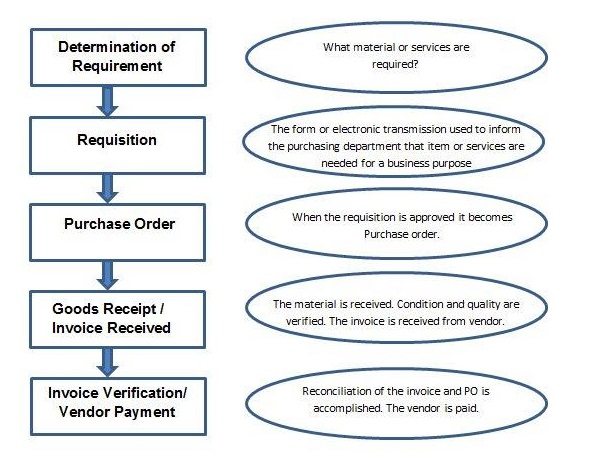
Basic Procurement activities flow is given in the following image:
SAP Basic Procurement
A brief introduction of Procurement activities is given below:
Procurement ActivitiesDescription
Determination of requirementIt is the logical subdivision where it is determined that what material or services are required to company, and which supplier can fulfill the requirement.
Creating Purchase RequisitionIt is the phase in which purchasing department is informed about the requirement of items or services required for business purpose. A requisition is a internal document.
Creating Purchase OrderIt is the phase when order is created from requisition and it is approved and assigned to a supplier.
Goods receipt/ Invoice ReceivedIt is the phase in which the material is received by the company and the condition and quality are verified. In this phase Invoice is received from the vendor (seller).
Invoice verification/ Vendor PaymentIt is the phase in which the vendor (seller) is paid from the company and reconciliation of the invoice and PO is accomplished.

Type of Basic Procurement

There are 2 types of Basic procurement which are shown below:
  • Procurement for Stock vs Consumption
  • External vs Internal Procurement

Procurement for Stock vs Consumption

The following points show the difference of Procurement for Stock vs. Consumption:
  • Procurement for Stock - A stock material is a material that is kept in stock. These materials are kept in stock once received from the vendor. The stock of this material keeps on increasing or decreasing based on amount of the quantity received or issued. To order a material for stock, the material must have a master record within the system.
  • Procurement for Direct Consumption - When procurement is for direct consumption i.e. it will be consumed as soon as it is received, the user should specify the consumption purpose. To order a material for consumption, the material may have a master record within the system.

External vs Internal Procurement

The following points show the difference of External vs Internal Procurement:
  • External procurement - It is the process of procuring goods or services from external vendors. There are 3 basic forms of external procurement generally supported by the Purchasing component of IT system.
    One time orders are generally used for material and services that are ordered irregularly.
    Longer-term contracts with the subsequent issue of release orders - For materials that are being ordered regularly and in large quantities, we can negotiate deal with the vendor (seller) for pricing or conditions & record then in a contract. In a contract you also specify the validity date.
    Longer-term scheduling agreements and delivery schedules - If a material is ordered on an everyday basis and is to be delivered according to an exact time schedule, then you set up a scheduling agreement.
  • Internal Procurement - Large corporate organizations may own multiple separate businesses or companies. Internal Procurement is process of getting material and services from among identical company. So, each of these companies maintains a complete bookkeeping system with separate Balance, Profit & Loss Statements so that when trade occurs between them it will be recorded.

Special Procurement

Special stocks are stocks that are managed differently as these stocks did not belong to company and these are being kept at some particular location. Special procurement and special stocks types are divided into the subsequent areas.

Consignment Stocks

Material that is available at our store premises, however it still belongs to the vendor (seller)/Owner of the material. If you utilize the material from consignment stocks, then you have to pay to the vendor.

Third-party processing

In third-party processing, a company passes on a sales order to associate external vendor (seller) who sends the goods directly to the customer. The sales order is not processed by your company, however by the vendor (seller). Third-party items can be entered in purchase requisitions, purchase orders and sales orders.

Pipeline handling

In pipeline handling, the company needs not to order or store the material involved. It is obtainable as and when required via a pipeline (for example, oil or water), or another style of cable (such as electricity). The material that is consumed is settled with the vendor (seller) on a regular basis.

Returnable Transport Stock

The company orders goods from a vendor (seller). The goods are delivered with returnable transport packaging (pallets, containers) that belongs to the vendor (seller) and is stored on the customer premises until they return it to the company.

Subcontracting

The vendor (the subcontractor) receives components from the ordering party with the help of which it produces a product. The product is ordered by your company through a purchase order. The components required by the vendor (seller) to manufacture the ordered product are listed in the purchase order and provided to the subcontractor.

Stock transfer using stock transport order

Goods are procured and supplied within a company. One plant order the goods internally from another plant (receiving plant/issuing plant). The goods are procured with a special type of purchase order - the stock transport order. You'll be able to request and monitor the transfer of goods with a stock transport order.